Legacy
Where to keep your will and important documents
Keep the originals of your will and important papers in one known place, such as with your lawyer or in a fire-resistant safe at home, and keep scans of all of them in one encrypted place that the right people can open. Then make sure 2 people know where both are.
A common problem isn’t losing a document. It’s a family that can’t find it, or finds 3 versions and doesn’t know which is current. One place for originals, one place for copies, and one note saying where they are solves most of it.
This is general information, not legal advice. The rules on where a will must be kept, and whether a copy is accepted, differ by state and country. A lawyer such as James Miller, the family lawyer in our examples, can tell you what applies to you.
The original will
Courts usually need the original signed will, not a copy. In many places, if the original can’t be found, the court may assume you revoked it, and a photocopy may not be enough. So the original deserves the most thought.
| Where | Good | Watch out for |
|---|---|---|
| With your lawyer | Safe, and they’ll know what to do | Make sure your family knows which firm, and keep a note if the firm changes |
| A court or state will registry, where offered | Official, hard to lose | Not offered everywhere; ask your lawyer |
| Fire-resistant safe at home | Your family can reach it quickly | Someone needs the combination or key; check it’s actually rated for fire |
| Bank safe deposit box | Secure | In some places a box can be hard to open quickly after a death, so ask a lawyer before relying on one for the will |
| A drawer or filing cabinet | Easy | Easy to lose, easy to damage, easy for anyone to read |
Wherever it is, write the location in your note and tell your executor.
The other originals
Put these together in one fire-resistant box or folder:
- life, home, car and health insurance policies;
- property deeds, mortgage papers and vehicle titles;
- birth, marriage and divorce certificates, passports and Social Security cards;
- pension and retirement account statements;
- trust documents, power of attorney and healthcare directive;
- the last 2 years of tax returns.
Keep the healthcare directive somewhere it can be found quickly while you’re alive, too. It’s needed in an emergency, not after one.
The scans
Originals can burn, flood or be 3,000 miles away when someone needs them. Scans let your family read a policy number at 2 a.m. or send a deed to a lawyer the same day. A scan won’t usually replace an original in court, but for finding things it’s what your family will use first.
What makes a good place for scans:
- Encrypted. These documents are a gift to identity thieves: passport numbers, account numbers, signatures. An ordinary folder in your Photos library or cloud drive is readable by anyone who gets into that account.
- Reachable by the right people, and only them. It does no good if nobody can open it later.
- Searchable. “Which insurer was the house with?” should take seconds.
Your options:
- A password manager’s secure documents, if it has emergency access set up. Good if you already use one. See password manager emergency access.
- An encrypted cloud folder, with the password handled the same way as your others.
- A Bunker Legacy Vault, described below.
- A USB drive in the same box as the originals. Simple, but it goes wherever the box goes, and a fire takes both.
Using Bunker for the scans
Bunker’s Document Scanner scans papers straight into a vault and reads the text on your device, so you can search inside them later. The vault is encrypted on your iPhone, iPad or Mac, and only its Pattern or its Recovery Phrase opens it.
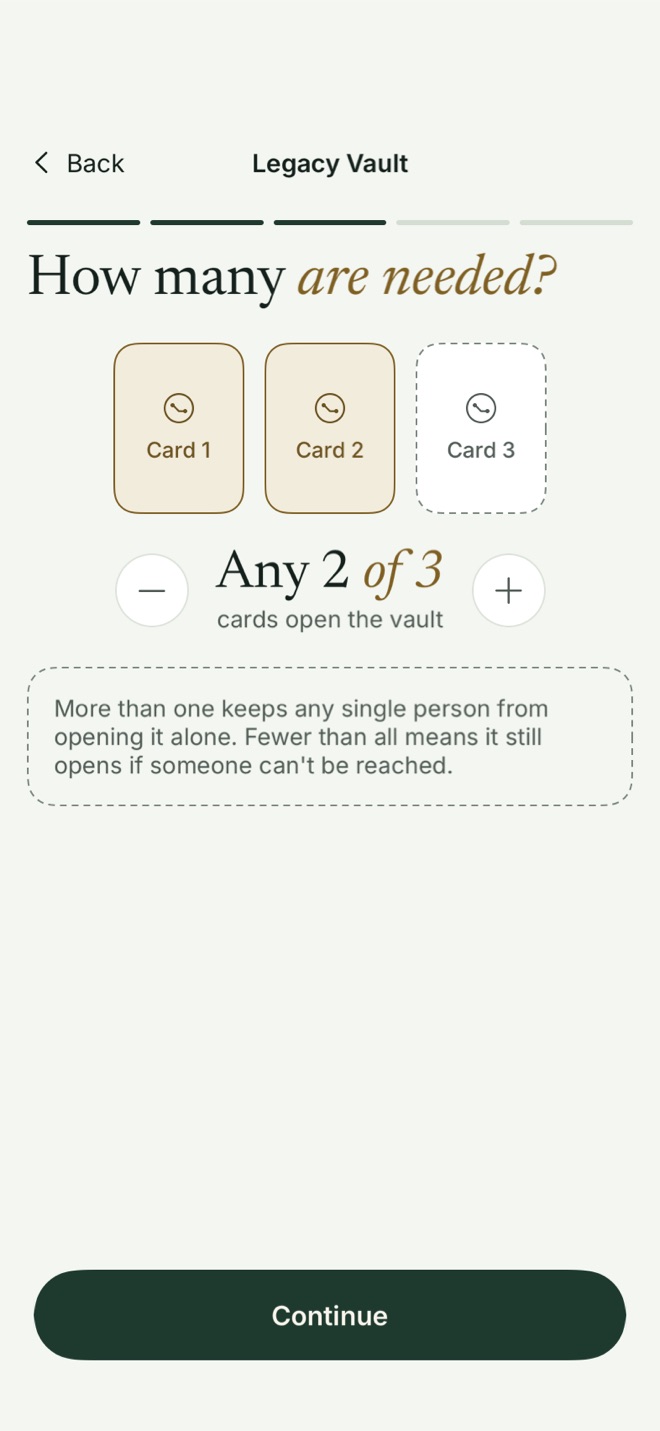
To make the scans reachable by your family, make that vault a Legacy Vault (Bunker Pro). You choose up to 5 trusted contacts and how many must come together, for example any 2 of 3. Each gets a printed Legacy Card, which is itself an important paper and can live with the originals. A card alone opens nothing, unless you chose a set of just 1. Together, enough cards open a read-only copy of that vault, which they can export. Your other vaults are never included.
Inside a Legacy Vault, a “What to include” card suggests the usual documents, and you can scan most of them in one tap. Bunker also suggests a letter to your trusted contacts, saying what’s in the vault and who should get what.
You can also export an offline Legacy archive, an encrypted file you can give to your lawyer on a USB drive. Any 2 cards (or however many you chose) open it, even without an internet connection. The archive is a snapshot: export a new one after you add documents. If you later issue new cards, an old archive still opens with the old cards, so destroy it.
What to know before you rely on it:
- Bunker can’t know whether you have died. In this version, enough trusted contacts acting together can open a Legacy Vault at any time, including while you’re alive. Bunker usually lets your devices know afterwards, but that’s best-effort. A waiting period is planned, not built yet. Choose people you’d trust with these papers today.
- The copy stored for your contacts has a 1 GB limit, and photos and videos in it are kept at Optimized quality. A folder of scanned documents is usually far below that.
- Don’t keep the cards together, and don’t keep a card inside the vault it opens.
If your family is happy with a filing box and a password manager, you don’t need Bunker for this.
The account list
One page, kept with the scans and with the originals:
- each bank, investment firm, insurer and pension provider;
- the type of account and the last 4 digits (never full numbers, and never passwords);
- a phone number for each.
This is what your executor will work from. It also shows quickly if something is missing.
An example
Sarah’s original will is with her lawyer, James Miller. Her other originals are in a fire-resistant box in her hall closet; her daughter Emma Clarke knows where the key is. She scans everything into a Bunker vault called “Family Papers”, adds her account list as a note, and makes it a Legacy Vault that any 2 of Emma, Olivia Bennett and James can open. She gives James an offline archive on a USB drive. Her one-page note says where all of this is, and James has a copy.